Akṣarā
  • Welcome
  • Programs
    • Events
    • Workshops
    • Classes
    • Program Pillars
  • Audiences
    • Kids & Families
    • Adults
    • Older Adults
  • Past Work
  • About
    • Mission & Values
    • Founder & Team
    • Awards And Press
    • Clients & Partners
  • Contact
  • More
    • Welcome
    • Programs
      • Events
      • Workshops
      • Classes
      • Program Pillars
    • Audiences
      • Kids & Families
      • Adults
      • Older Adults
    • Past Work
    • About
      • Mission & Values
      • Founder & Team
      • Awards And Press
      • Clients & Partners
    • Contact
Akṣarā
  • Welcome
  • Programs
    • Events
    • Workshops
    • Classes
    • Program Pillars
  • Audiences
    • Kids & Families
    • Adults
    • Older Adults
  • Past Work
  • About
    • Mission & Values
    • Founder & Team
    • Awards And Press
    • Clients & Partners
  • Contact

CREATIVE ARTS PROGRAM

A semester-lomg curriculum

Ephemeral Art of Kolam

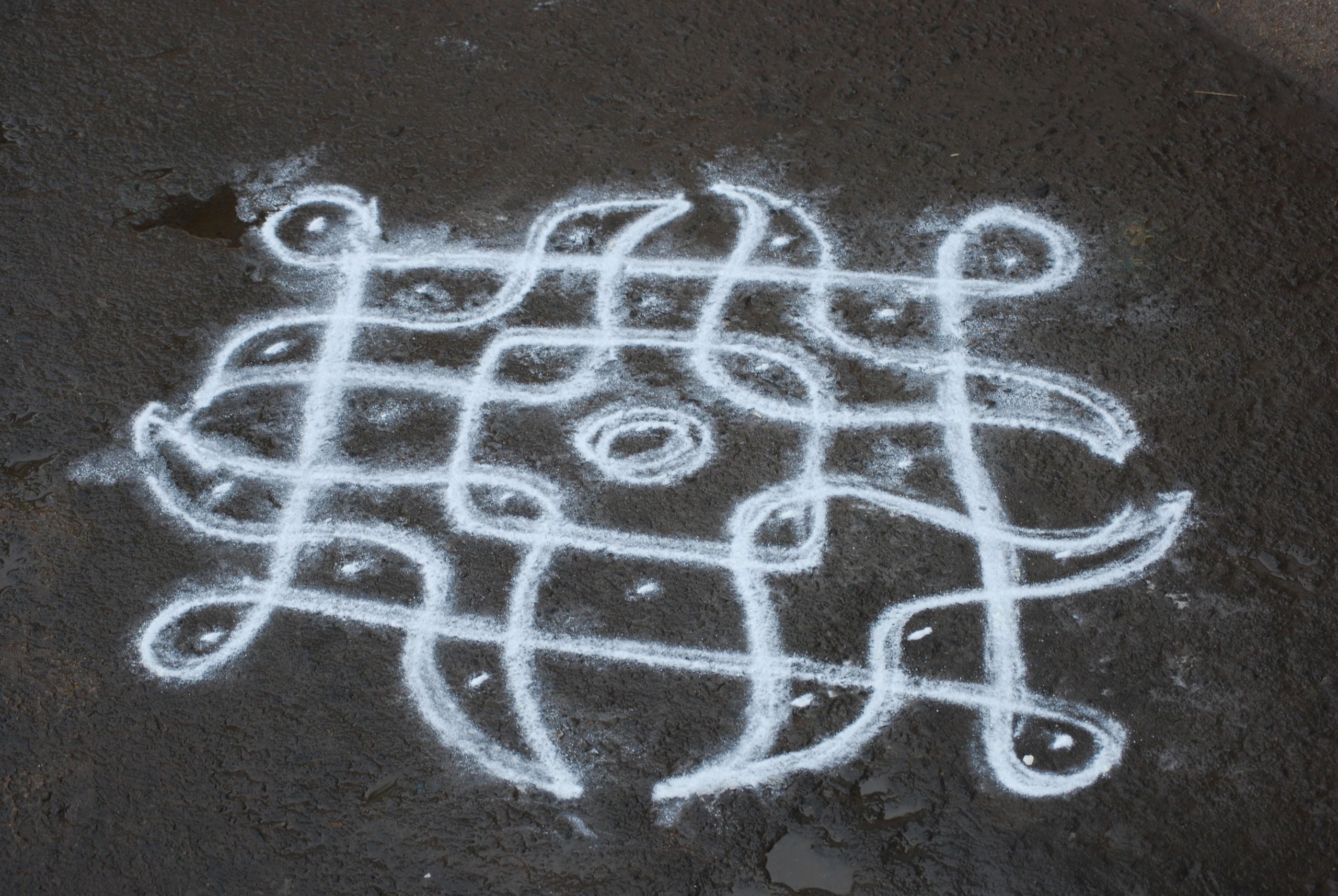
Kolam is a traditional Indian art form that blends aesthetics, mathematics, and spirituality into intricate, temporary designs. Originating in Tamil Nadu and practiced across South India, Kolam is drawn daily on thresholds using rice flour, chalk powder, or rock powder.


What wILL WE LEARN?

Origins of Kōlam

Understand deeper the social, cultural and spiritual significance of this ancient-living art form from India.

Learn to draw Kōlam designs

We will learn to draw Kōlam in two distinct ways--Sikku Kōlam, where lines go around the dots and Kambi Kōlam, where lines are drawn connecting the dots.

Learn to draw with rice flour

Learning to draw with rice flour using bare fingers. At first we learnt how to draw simple lines, dots, and curves (the basic shapes of Kōlam) with our fingers using rice flour.

Understanding the math and science of Kōlam

Every 2 weeks we touched upon different math and science theories/concepts that relate to drawing Kōlams. These theories/concepts range from Symmetry to Array Grammar, Tessellations, and, Fibonacci

Final project & presentation

After internalizing all of the above, we will embark on our own journey to see and interpret kolam in relationship to our lives. We will work towards a final presentation that will be a community event where you will showcase your learning.

A class in progress

How did THEY learn?

For 3 months we met every Friday for 2hrs

We were a small cohort of participants and that was just fine, especially given how little people know about this art form from India. I am thankful for those who came and were ready to be guided and surprised by this new art form. We had a multiracial mix of participants. 


We used multimedia in class and used them solely to guide our practice and gain a deeper understanding of this art form. We had digital screen to dispense lesson ideas, large and small format drawing paper to draw with oil pastels, colored pencils, and paint, PVC boards on which we drew with rice flour and mathematical pattern blocks that helped us think. We mostly worked sitting at the table but after a few classes, our adventurous learners started challenging themselves to draw on the floor. 


Every class culminated in home-cooked rice snacks. We became those artists who drew with rice flour and also ate them!

Learning to draw basic lines, dots, and curves with bare fingers and rice flour

    OUR PROGRAM PARTICIPANTS

    ALAN STRICOFF

    ALAN STRICOFF

    ALAN STRICOFF

    "I got interested in the meeting point of Kōlam with nature."

    Learn More

    NANDAN BARUAH

    ALAN STRICOFF

    ALAN STRICOFF

    "I got interested in the meeting point of a daily practice of Kōlam and life."

    Learn More

    MAGGY S

    ALAN STRICOFF

    MAGGY S

    "I got interested in the meeting point of Kolam with math."

    Learn More

    MORNINGSIDE GARDEN COMMUNITY IN THE UPPER WEST SIDE OF MANHATTAN

    COLLABORATING PARTNERS

    LMCC SU-CASA

    SU-CASA, is a community arts engagement program supported by public funds from the New York City Council, in partnership with the New York City Department of Cultural Affairs (DCLA) and the Department for the Aging (DFTA). Lower Manhattan Cultural Council, LMCC the arts organization that administers this award places artists and art organizations in senior centers in New York City. LMCC's mission is t create a fertile and nurturing environment for artists and arts groups, enlivening public spaces with free programs in the visual, performing, and new media arts, and to provide leadership in cultural planning and advocacy. 

    JAYANTHI MOORTHY

    Earlier this year Jayanthi Moorthy a visual artist, educator, and founder of Aksara was awarded to be a participant in the LMCC SU-CASA program. Ms. Moorthy has been culturally trained in this art form since when she was a child. As an artist in NYC, she used the Kōlam and rangoli ways of drawing as her means of self-expression to make large ephemeral installations that combined rice flour, spices, and digital animated projections. You can find more about her works here: www.jaymoorthy.com

    MRHS

    MRHS

    Morningside Retirement & Health Services (MRHS) serves Morningside Gardens, a cooperative housing development of 980 apartments in Morningside Heights on Manhattan’s Upper West Side. It was among the city’s first middle-income, multiracial cooperatives when it opened in 1957. MRHS brings diverse social, educational, and recreational programs into the community which are made available to all residents of Morningside Gardens. One of the overarching goals of MRHS as spoken by Ron Bruno, the Executive Director there, "To assist seniors by providing them quality life-style through diverse programs in exercise, writing, films, theatre and visual arts and provide them with a sense of community.

    I thought the entire experience from the classes to the finale was excellent and opened my eyes to a new form of expression and way of looking at things.


    Alan S from the class, Ephemeral Art Of Kolam

    Artwork by Alan Stricoff

    Copyright © 2021 Akṣarā - All Rights Reserved.

    This website uses cookies.

    We use cookies to analyze website traffic and optimize your website experience. By accepting our use of cookies, your data will be aggregated with all other user data.

    Accept