Akṣarā
  • Welcome
  • Programs
    • Events
    • Workshops
    • Classes
    • Program Pillars
  • Audiences
    • Kids & Families
    • Adults
    • Older Adults
  • Past Work
  • About
    • Mission & Values
    • Founder & Team
    • Awards And Press
    • Clients & Partners
  • Contact
  • More
    • Welcome
    • Programs
      • Events
      • Workshops
      • Classes
      • Program Pillars
    • Audiences
      • Kids & Families
      • Adults
      • Older Adults
    • Past Work
    • About
      • Mission & Values
      • Founder & Team
      • Awards And Press
      • Clients & Partners
    • Contact
Akṣarā
  • Welcome
  • Programs
    • Events
    • Workshops
    • Classes
    • Program Pillars
  • Audiences
    • Kids & Families
    • Adults
    • Older Adults
  • Past Work
  • About
    • Mission & Values
    • Founder & Team
    • Awards And Press
    • Clients & Partners
  • Contact

WORKSHOP SERIES

For Older Adults

Ephemeral Art of Kolam

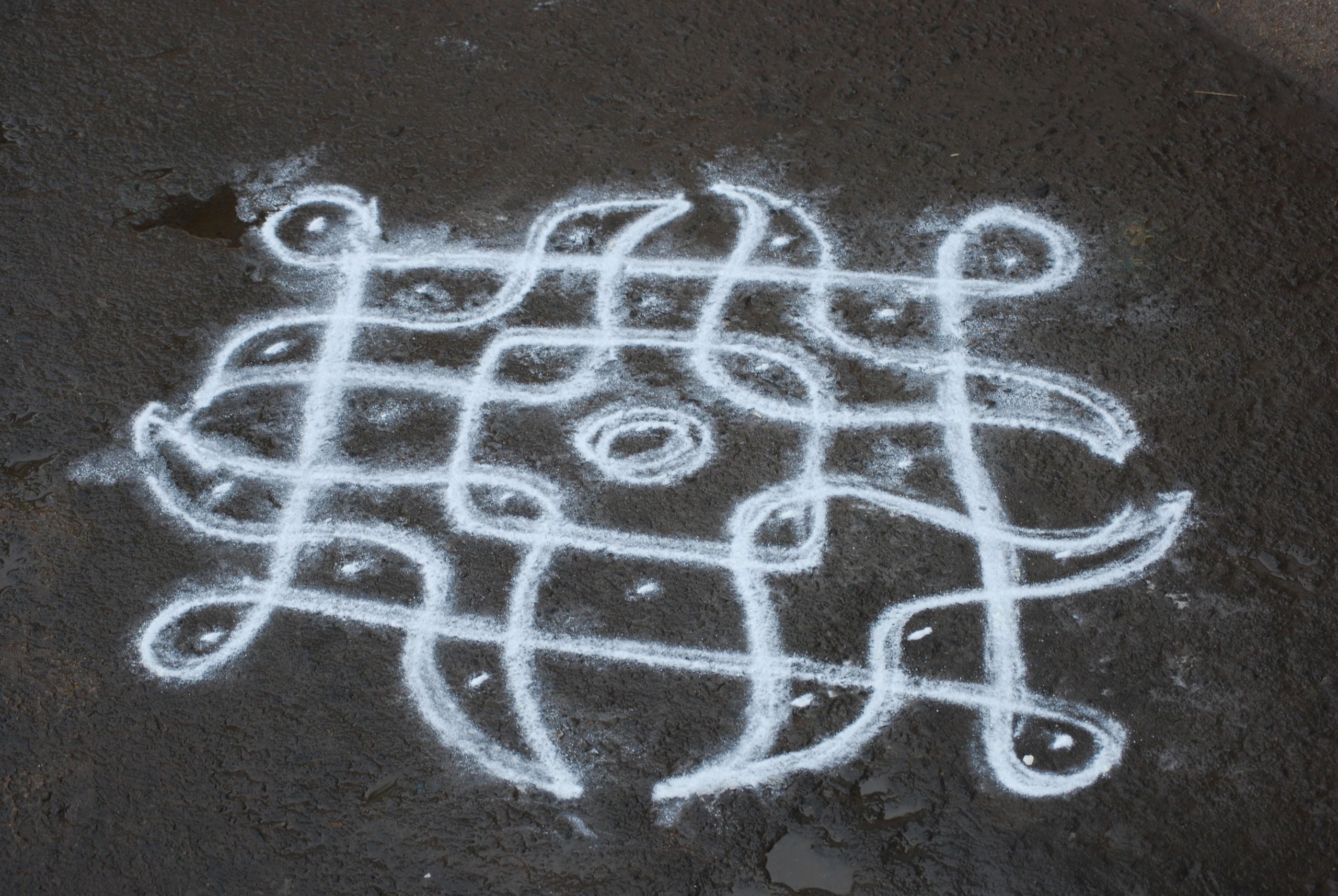
Kolam is a traditional Indian art form that blends aesthetics, mathematics, and spirituality into intricate, temporary designs. Originating in Tamil Nadu and practiced across South India, Kolam is drawn daily on thresholds using rice flour, chalk powder, or rock powder.


Project Goal

To foster creativity, cognitive engagement, and cultural connection among older adults through a workshop series on the Indian ephemeral art of Kolam—an age-old South Indian practice that intertwines artistic expression, mathematical precision, and spiritual mindfulness. The series aims to promote well-being, community interaction, and intergenerational exchange by enabling participants to learn, create, and reflect through the rhythmic, meditative process of Kolam drawing.

Our classes

    Our Participants

    Our participants were long-time residents of the River Terrace NORC (Naturally Occurring Retirement Community)—many having lived in the building for over 40 years. Most were over 70, with one vibrant participant in her 80s, who remained one of the most engaged learners throughout the course.


    The group was a beautiful reflection of New York’s diversity, including individuals from Black, Hispanic, and American Indian backgrounds—all proudly identifying as New Yorkers. And they embodied that spirit—stylish, multi-tasking, and curious, with a deep appreciation for the arts. Their professional pasts were just as rich, ranging from careers in the fashion industry to education.


    Some participants grasped the art of Kōlam quickly, while others needed time to understand the rhythmic flow of lines. But through patience, consistent practice, and personalized guidance, every learner found their own graceful entry into this intricate, meditative form.

    Berta

    Jeanette

    Jeanette

    "“The Kolam class was meditative and calming. My detail-oriented lifestyle really informed how I approached my drawings.”

    Jeanette

    Jeanette

    Jeanette

    "It’s so meditative and satisfying—especially when you guide a single, unbroken line to weave smoothly around all the dots."

    Zella

    Jeanette

    Zella

    "Aah! So that’s how the lines move—up, down, and all around!  

    Drawing kolam designs made me feel good about myself. It was relaxing."

    Angie

    Angie

    Zella

    "I found the classes interesting, challenging, and enlightening. I am eager to try making my own repeated patterns with these dots and lines."

    Myrna

    Angie

    Myrna

    "Each Kōlam felt like solving a beautiful puzzle—completing one only made me more excited to try the next, more intricate design. The instructor was incredibly patient and welcoming, and I truly appreciated the delicious, homemade Indian rice-based dishes she thoughtfully prepared for every session." 

    Gwen

    Angie

    Myrna

    "I attended a few classes and I was very interested in using this art form to relieve stress and to help me be more organized."

    How did THEY learn?

    For 3 months we met every Thursday for 2hrs

    We were a small but enthusiastic cohort—just right for introducing a lesser-known Indian art form to new audiences. I’m grateful for those who showed up with open minds, ready to be guided and surprised. Our participants reflected a beautifully multiracial mix, adding depth to our shared learning.


    Multimedia tools supported our exploration: digital screens for lesson prompts, large and small paper for drawing with oil pastels and paint, PVC boards for rice flour designs, and mathematical pattern blocks to spark new ideas. We mostly worked at tables. Every class started with a floor drawing demonstration by me showing how easy it was to work on the floor and the number of health benefits it had. Drawing this way also embraced the traditional form of kolam drawing.


    Each class ended on a warm note—with home-cooked rice-based dishes, and tea. After all, we were artists who both drew with rice flour and ate it too!

    What DID THEY LEARN?

    The Origins of Kōlam

    Gained a deeper understanding of the cultural, social, and spiritual significance of this ancient yet living art form from India.

    Drawing Kōlam Designs

    Learned two distinct styles: Sikku Kōlam, where lines loop around dots, and Kambi Kōlam, where lines connect the dots.

    Drawing with Rice Flour

    Practiced the traditional method of drawing with rice flour and bare fingers—starting with basic lines, dots, and curves that form the foundation of Kōlam.

    Math & Science in Kōlam

    Explored mathematical and scientific concepts embedded in Kōlam, such as symmetry, tessellations, array grammar, and even Fibonacci sequences.

    Final Project & Community Showcase

    Synthesized learnings into a personal interpretation of Kōlam, culminating in a final presentation at a community event to share reflections, stories, and art.

    About the center

    River Terrace Co-op Apartments & NORC, Upper West Side, Manhattan

    River Terrace Apartments (158th Street & Riverside Drive Housing Co.) is a 431 unit Mitchell-Lama Cooperative located in Uptown Manhattan on Riverside Drive West between 155th and 158th Streets. Situated in historic Audubon Terrace, the building straddles Harlem and Washington Heights communities.  

    NOTES FOR THE FUTURE

    Develop A Kolam Product

    Design Summer Classes For Kids

    Design Summer Classes For Kids

    Inspired by how much participants enjoy the daily rhythm and meditative quality of drawing kōlams, I’ve begun developing a product titled Kolam Connections. Currently in its beta stage, this product is designed to support regular kōlam practice and deeper engagement with its patterns and meanings. I introduced the concept to my older adult learners to gather feedback and explore its usefulness in sustaining their interest beyond the class setting. 

    Design Summer Classes For Kids

    Design Summer Classes For Kids

    Design Summer Classes For Kids

    One of the older adult participants shared her wish for a kōlam workshop series designed for children, particularly for her grandchildren to experience what she described as a joyful and enriching engagement. She expressed that such a summer program would allow younger generations to connect with the cultural tradition in a playful and hands-on way, while also sharing in the intergenerational joy that kōlam can offer.

    COLLABORATING PARTNERS

    LMCC SU-CASA

    SU-CASA, is a community arts engagement program supported by public funds from the New York City Council, in partnership with the New York City Department of Cultural Affairs (DCLA) and the Department for the Aging (DFTA). Lower Manhattan Cultural Council, LMCC the arts organization that administers this award places artists and art organizations in senior centers in New York City. LMCC's mission is t create a fertile and nurturing environment for artists and arts groups, enlivening public spaces with free programs in the visual, performing, and new media arts, and to provide leadership in cultural planning and advocacy. 

    JAYANTHI MOORTHY

    Jayanthi Moorthy is a visual artist, educator, and founder of Aksarā—an arts initiative dedicated to promoting Indian cultural education through the arts. With a contemporary practice rooted in Asian philosophies of centrality and impermanence, she creates paintings, prints, and digital installations inspired by ephemeral floor drawings made with rice flour, sand, and spices. Through Aksarā, she explores Indian art forms in depth and designs engaging workshops and classes for children, adults, and older adults alike. Learn more about her artistic work here www.jaymoorthy.com. Learn more about her arts initiative here www.aksara.us

    MJHS

    MJHS

    MJHS Health System, founded in 1907 by the visionary "Brooklyn Ladies," is dedicated to providing compassionate, high-quality health and community-based services across the greater New York area. What began as a mission to care for frail, elderly members of the Jewish community has grown into a premier, inclusive health system committed to meeting the diverse needs of individuals and families across the continuum of care.

    Copyright © 2021 Akṣarā - All Rights Reserved.

    This website uses cookies.

    We use cookies to analyze website traffic and optimize your website experience. By accepting our use of cookies, your data will be aggregated with all other user data.

    Accept